

Standard Basketball Court Specifications: Dimensions, Layout, and Markings
Advertisements
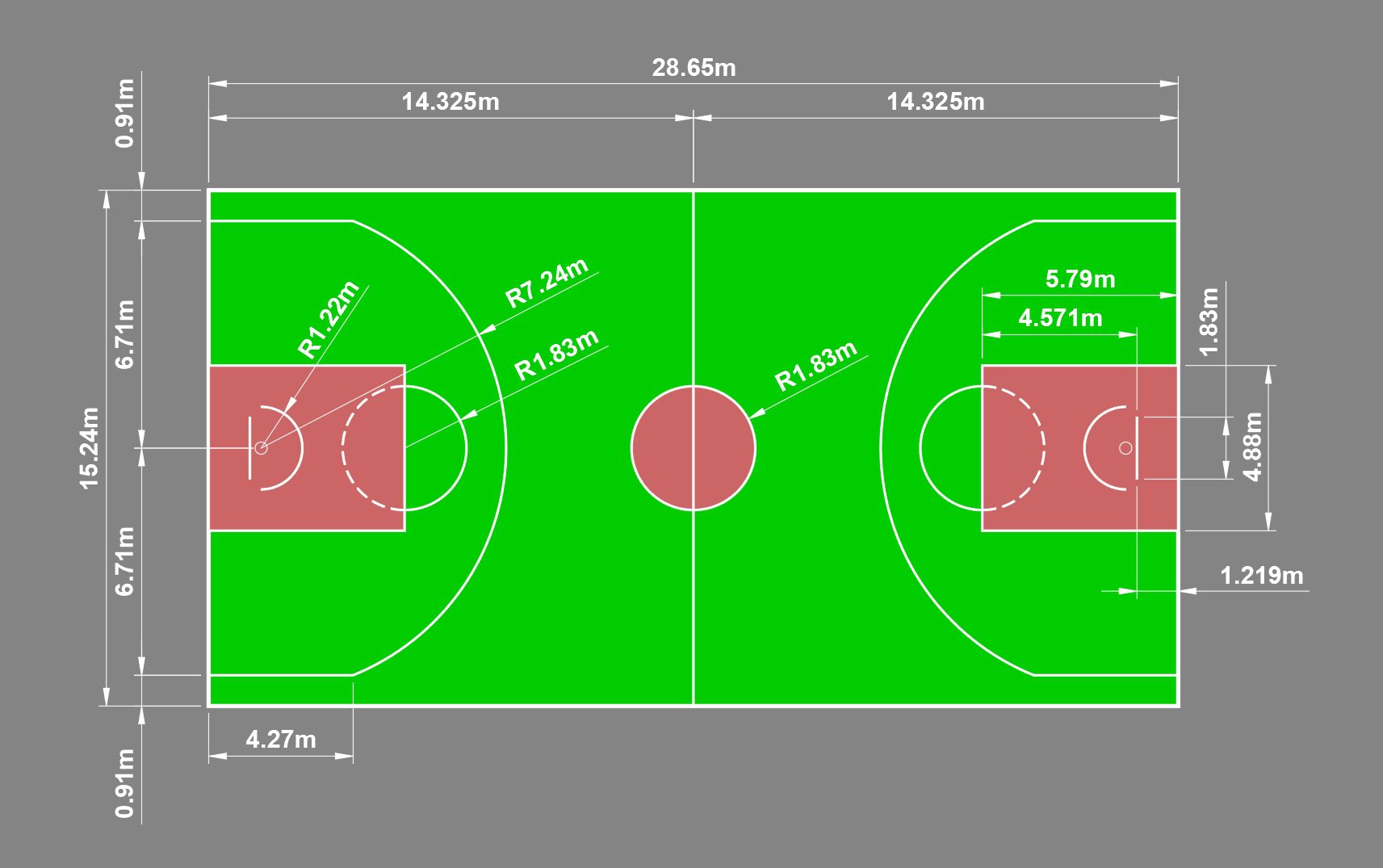
The basketball court constitutes a precisely delineated playing area characterized by specific dimensions, prescribed markings, and designated equipment. A thorough comprehension of official court size and layout parameters is fundamental for participants, coaching staff, officials, and facility operators across all levels of play, from professional leagues to recreational settings. This comprehensive guide is designed to detail the established specifications for basketball courts, encompassing dimensions sanctioned by major governing bodies such as the NBA, FIBA, and NCAA, as well as high school standards. We will examine key court markings and provide professional considerations for court setup to ensure an optimal playing environment.
Standard Basketball Court Dimensions and Configurations
Prescribed Dimensions Across Governing Bodies
The precise dimensions of a basketball court vary slightly, contingent upon the specific governing body or competitive league overseeing play.
- NBA & FIBA (International Standard): 28.65 meters in length (equivalent to 94 feet) by 15.24 meters in width (equivalent to 50 feet).
- NCAA (Collegiate Standard): Adheres to the same dimensions as the international standard, measuring 28.65 meters in length (94 feet) by 15.24 meters in width (50 feet).
- High School Standard: Utilizes slightly reduced dimensions, specified as 25.6 meters in length (84 feet) by 15.24 meters in width (50 feet).
Half-Court Specifications
A half-court configuration precisely represents one half of a full court’s length, maintaining the full court’s width. The specified lengths for half-courts are as follows:
- NBA & NCAA: 14.33 meters (47 feet).
- High School: 12.8 meters (42 feet).
Key Court Markings and Their Significance
The lines and areas delineated on a basketball court serve to define crucial zones and facilitate regulated gameplay.
- Center Circle: Situated at the precise midpoint of the court, this circular area is the designated location for initiating the game via a jump ball.
- Three-Point Line: This arc delineates the area from which a successful field goal is awarded three points. The distance of this line from the hoop varies by governing body:
NBA: 7.24 meters (23 feet 9 inches).
FIBA & NCAA: 6.75 meters (22 feet 1.75 inches).
High School: 6.02 meters (19 feet 9 inches). - Free Throw Line and The Key (Paint Area):
Free Throw Line: Positioned 4.57 meters (15 feet) from the plane of the backboard.
The Key (Paint Area or Lane): This rectangular area extending from the free throw line to the baseline has a prescribed width: 4.88 meters (16 feet) in the NBA and 3.66 meters (12 feet) in NCAA and high school play. - Baseline and Sidelines:
Baseline: Defines the court boundary situated directly behind each basket.
Sidelines: Constitute the longitudinal boundaries extending along the entire length of the playing area.
Official Hoop and Backboard Specifications
The specifications for the basketball hoop and backboard are standardized across most levels of organized play:
- Rim Height: The top of the rim is set at a standard height of 3.05 meters (10 feet) above the playing surface.
- Backboard Dimensions: The standard backboard measures 1.83 meters (6 feet) in width by 1.07 meters (3.5 feet) in height.
- Rim Diameter: The interior diameter of the rim is precisely 45.7 cm (18 inches).
Prescribed Playing Surfaces
Basketball courts are constructed using materials suited to their environment and intended use.
- Indoor Basketball Courts: Traditionally surfaced with hardwood flooring, most commonly maple, providing a consistent bounce and player comfort.
- Outdoor Basketball Courts: Constructed utilizing durable materials such as asphalt, concrete, or specialized synthetic coatings designed to withstand environmental elements and heavy usage.
Professional Considerations for Court Setup
Establishing a basketball court involves adherence to precise measurements and proper equipment installation.
- Accurate Measurement and Marking: Employ precise measuring instruments and appropriate marking materials (e.g., paint, chalk) to delineate all court boundaries and lines according to the required dimensions.
- Proper Hoop and Backboard Installation: Ensure the basketball hoop’s rim is securely mounted at the mandated height of 3.05 meters (10 feet) and that the backboard is firmly affixed according to manufacturer specifications.
- Playing Surface Maintenance: Regular and appropriate maintenance procedures, including cleaning, repair, and potential resurfacing, are essential to preserve optimal grip, player safety, and the longevity of the court surface.
Frequently Asked Questions (FAQs)
Addressing common inquiries regarding basketball court specifications:
- What are the primary dimensional differences between an NBA and a high school basketball court? The principal difference lies in the court length; NBA courts measure 94 feet, whereas high school courts are 84 feet long. Additionally, the distance of the three-point line from the hoop varies significantly between these levels.
- Is it feasible to construct a basketball court in a residential setting? Yes, it is indeed feasible to establish a basketball court in a residential environment. This can typically be accomplished by installing a portable or in-ground hoop and accurately marking the relevant court boundaries on a suitable paved area.
- What materials are considered optimal for basketball court surfaces? For indoor courts, hardwood is generally considered the superior surface. For outdoor applications, durable materials such as asphalt or concrete, often finished with a specialized coating, are typically employed.
Concluding Remarks
A comprehensive understanding of basketball court layout, prescribed dimensions, and essential technical features is paramount for all stakeholders, including players, coaching staff, facility managers, and court constructors. Adherence to these established guidelines, whether designing a full-court or half-court configuration, is fundamental to ensuring an optimal, safe, and regulation-compliant playing experience.
You can download the CAD file below for reference:
- File format: .DWG
- Size: 37 KB
- Source: Collect
- AutoCAD platform 2018 and later versions. For downloading files there is no need to go through the registration process
Advertisements